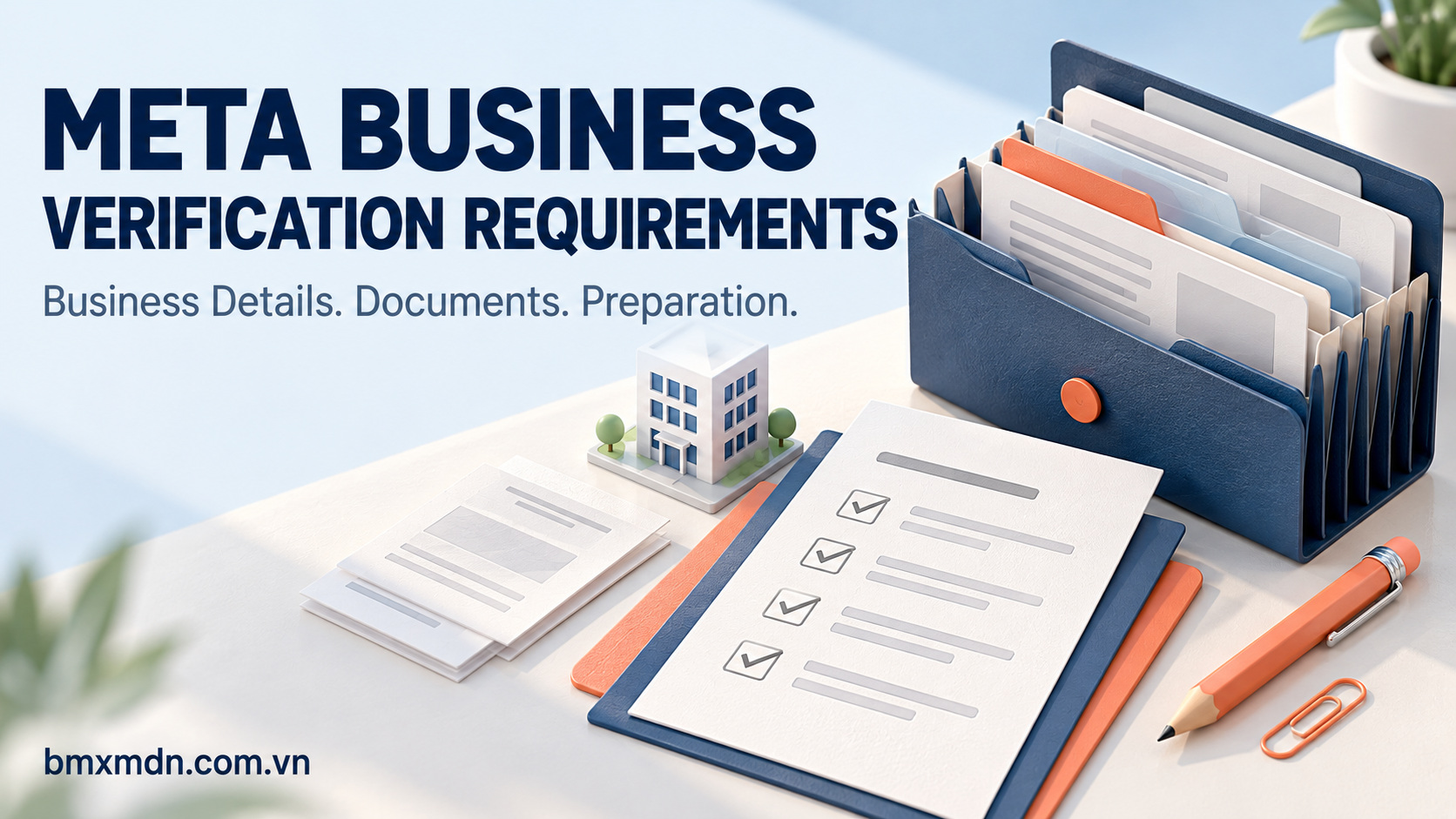
Meta Business Verification Documents: What to Prepare
Preparing your Meta Business Verification documents starts with understanding what information the verification request asks you to prove.
A document showing a business name may not establish its current address. A bill showing an address may not be suitable for confirming the legal business name. Choosing evidence for the specific request is more useful than uploading every business record you have.
This guide explains the document categories you may encounter and provides a practical checklist for organizing your submission.
Which Documents May Be Requested?
Document requirements depend on the country and verification flow. Follow the accepted-document options displayed in your account rather than treating any general list as universally applicable. 360dialog’s client documentation also notes that accepted legal documents vary by country.
Its published business verification guide lists these categories:
-
Certificate or Articles of Incorporation.
-
Business registration or license document.
-
Government-issued business tax document.
-
Business bank statement.
-
Utility bill, with limitations on what it can verify.
The guide distinguishes utility bills used for address or phone verification from evidence for the legal business name, and excludes self-filed tax documents from the government-issued tax-document category.
These are categories to check against your account’s request, not a promise that a particular file will be accepted.
Match Each Document to the Information Requested
Before uploading a file, identify which detail it is intended to support.
| Information being checked |
What to inspect in your records |
| Legal business name |
The registered entity name and issuing authority |
| Business address |
The address shown and whether it describes the relevant business |
| Business phone number |
Whether the requested number appears in suitable supporting evidence |
| Document validity |
Issue date, expiry date where applicable, and any stated recency requirement |
| Business consistency |
Whether the records concern the same entity as the submission |
This prevents a common preparation mistake: choosing an official-looking document without checking whether it contains the information being requested.
For assistance with preparation, explore the Meta Business Verification and Tech Provider services listed on BMXMDN. Ask the provider to explain which document review and preparation tasks are included.
1. Confirm the Correct Legal Business Name
Compare the name entered in the submission with the name on the supporting record.
Pay attention to legal suffixes, spelling, and whether you have entered a trading name instead of the registered entity name.
For example, a store might trade under a short brand name while its registration identifies a longer company name. Understand that relationship before submitting the information.
Gupshup’s verification guidance specifically calls for the legal entity name in the submitted document to match the legal entity name provided during the process.
If an official record contains an error, seek a correction through the issuing organization. Do not edit the document to make it match the application.
2. Review Address and Phone Evidence Separately
Check the exact detail that the request concerns.
If your business has moved, identify which records show the current address and which contain an older one. Do not combine details from different locations without understanding the discrepancy.
If phone evidence is requested, inspect whether the document actually displays the relevant number.
A practical review should answer:
-
Does this record concern the correct business?
-
Does it contain the requested detail?
-
Is that detail consistent with the submission?
-
Is the document type offered as an accepted option for this request?
Where suitable evidence is unavailable, review the alternatives offered in the verification flow or seek clarification through the available support route.
3. Prepare Complete, Readable Files
Review each file before uploading it.
Open it at a normal viewing size and check that names, addresses, dates, and issuer information can be read. Include the pages needed to understand the record.
For photographs or scans, avoid glare, heavy shadows, blurred text, and cropped edges. Use an authentic copy and preserve the document’s information.
Check the upload screen for permitted formats, file sizes, and page requirements. Do not assume that specifications from another verification process apply.
Avoid combining unrelated documents into a decorative presentation. The purpose is to provide clear evidence, not a redesigned version of the original records.
4. Check Language and Translation Instructions
If your records use a language different from the verification interface, check the instructions for supported languages and any translation requirements.
Do not assume that an informal translation is sufficient. Equally, do not arrange a translation solely because a third-party checklist says every document must be in English.
Where a translation is requested, follow the stated conditions and retain the original document.
Keep names, registration details, and addresses consistent across the original and translated versions.
5. Organize a Simple Document Register
A small internal register helps your team track what has been reviewed and submitted.
| File |
Purpose |
Review status |
| Registration record |
Support the legal entity information |
Name and issuing details checked |
| Address evidence |
Support the requested location |
Address compared with submission |
| Phone evidence, if requested |
Support the business number |
Number checked |
| Translation, if requested |
Meet the stated language requirement |
Checked against the original |
| Submission record |
Track the application |
Date and responsible person recorded |
Use descriptive filenames so the responsible person can identify the correct version.
Store documents securely and share them only with people who need them for the agreed task. Keep passwords and authentication codes out of the document register.
What to Do if a Document Is Rejected
Start with the explanation displayed for your submission.
Identify whether the issue concerns the document category, missing information, readability, a mismatch, or another stated condition.
Then compare the rejected file with the requirement. Correct the specific problem before submitting a replacement.
For example, a sharper scan will not resolve a name mismatch. A different document will not help if it also lacks the requested address.
Keep a record of what changed so your team can respond consistently to follow-up questions.
Pre-Submission Checklist
Before completing the upload, confirm that:
-
The records concern the business you are authorized to represent.
-
Each file supports the detail being checked.
-
The business information is accurate and consistent.
-
The selected document category matches the file.
-
Relevant information is complete and readable.
-
You have followed any validity, language, and upload requirements.
-
One person is responsible for monitoring the response.
This checklist helps organize a submission; it does not guarantee approval.
Frequently Asked Questions
Is a business registration document always enough?
Not necessarily. Check which details it contains and whether the verification flow requests additional evidence.
Can I use a utility bill for every verification requirement?
Do not treat it as universal evidence. Match the document to the specific information check and the accepted options shown in your account.
Should I upload all available business documents?
Submit what the request requires. Organize additional records for follow-up rather than assuming that more files will resolve an unclear submission.
Can a service provider create missing official documents?
Official records should come from their legitimate issuing organizations. A provider can help you understand and organize requirements, but should not fabricate or alter evidence.
Does a document review service guarantee acceptance?
No. Ask the provider to define its review and preparation work separately from the platform’s decision.
Get Help Preparing Your Meta Business Verification Documents
Preparing a clear submission means choosing relevant records, checking consistency, and following the document request shown in your account.
A useful review identifies missing information and discrepancies before submission. It should also clarify which tasks belong to your team and which assistance a provider will deliver.
If you need assistance reviewing your situation, visit BMXMDN and explain the requirement you are trying to satisfy. Request a proposal that clearly identifies the work included, the information you must provide, and how progress will be documented.